

A useful pour-over coffee scale should support the total loaded brewing setup, display changes clearly, respond predictably and remain usable through your recipe. A 0.1-gram display increment is a resolution specification, not proof of accuracy to 0.1 gram. Start with capacity, platform fit and stable weighing before comparing automatic brewing modes.
This buying guide explains what to verify and provides three relevant catalogue listings. We have not independently measured their accuracy, response times or water resistance. No product is awarded an overall winner based on invented testing or a specification that has not been verified for the exact model.
Separate resolution, accuracy and repeatability
Resolution is the smallest change shown on the display in a given mode or load range. Accuracy concerns how close a reading is to the actual mass. Repeatability concerns how closely repeated readings agree under comparable conditions. A scale can display many digits without those digits establishing its accuracy.
Acaia’s weighing-resolution explanation explicitly distinguishes display resolution from accuracy. Use that distinction when reading other brands’ listings too, but do not transfer Acaia’s model specifications to a different product. Check the exact scale’s documentation for capacity, load-dependent resolution and any stated accuracy conditions.
| Term | Useful question | Do not assume |
|---|---|---|
| Resolution | What increments appear in this mode and load range? | Every displayed digit is an accuracy guarantee |
| Capacity | Can it support the complete loaded setup? | Taring removes physical load |
| Response | How does the reading follow additions of water? | A feature label proves zero delay |
| Repeatability | Do comparable weighings return similar readings? | One successful reading establishes long-term performance |
Calculate the full load, even after taring
The platform supports the server, dripper, filter, grounds and water together. Pressing tare changes the displayed zero; it does not remove their weight from the scale. Check maximum capacity with the full setup in mind and follow the manufacturer’s overload precautions.
For an illustrative calculation, suppose a server weighs 450 grams, a dripper 200 grams, coffee 30 grams and the planned water input 500 grams. The combined input load is 1,180 grams before accounting for other components. These are example numbers, not measurements of any product below. Weigh your own equipment rather than relying on the illustration.
Also check platform dimensions and balance. A server can fit a capacity rating but sit awkwardly on a small platform, obscure the display or interfere with controls. Do not let a vessel rest partly on a counter or touch another surface, because the scale may then receive only part of its load.
Choose a readable, stable brewing layout
Place the scale on a level, stable surface and keep the setup clear of vibration. Acaia’s stable-environment guidance explains why movement can affect readings. For another scale, consult its own operating requirements rather than assuming every compensation feature behaves identically.
Check whether you can read the weight and timer without bending near hot water. Buttons should remain accessible with the brewer in place. A timer is convenient, but a separate timer can be sufficient if the weighing function meets your needs. Choose a layout that does not require reaching over a full dripper to operate controls.
Response matters during pouring because the display is your feedback. Look for evidence that describes the measurement method when a review claims a response time. Avoid treating words such as instant or professional as measured results. This guide does not assign an unverified millisecond figure to any listing.
Check automatic modes and auto-off behaviour
Automatic timers and flow-related displays can be useful only if their triggers match your workflow. Read how a mode starts, pauses and resets. A mistaken reset during brewing can be more disruptive than using a straightforward manual timer.
Check auto-off settings for the intended brewing duration and whether a low battery changes operation. Practise mode selection with a safe, empty setup before using hot water. Do not assume an espresso-oriented automatic mode is also appropriate for a pour-over server and several staged pours.
Protect the scale according to its actual rating
Water resistance and waterproofing are not interchangeable. Verify the manufacturer’s stated protection, its limitations and its cleaning instructions. Do not immerse a scale or rinse its charging port unless the manufacturer expressly permits that procedure.
Use any heat-resistant pad as instructed and make sure it does not cause the vessel to touch surrounding surfaces. Keep charging equipment away from spills and follow the device’s charging instructions. A coffee-oriented product photograph is not evidence that every component tolerates hot water or unrestricted washing.
Compare the three catalogue options
The following listings are pour-over scale shopping options, not a tested performance ranking. Verify the current model, capacity, dimensions, included accessories and warranty in the listing and manufacturer documentation. A changed variant can have different features even when a familiar brand name appears.
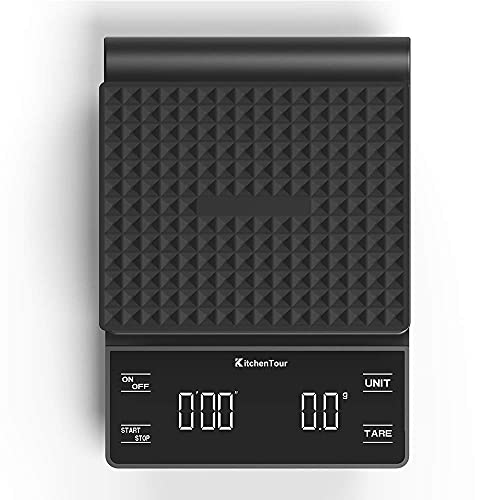
Pros
- Accurate to 0.1g
- Built-in timer
- Large 3kg capacity
- Easy tare function
- Affordable price
Cons
- Slow response on pour
- Not waterproof
- Lag in accuracy
Specifications
| Color | Black |
|---|---|
| Size | EK6002 |
| Dimensions | 8.49999999133 x 6.42125983597 x 1.53937007717 inches |
| Weight | 0.5952481074 pounds |
| Product Group | Kitchen |
| Binding | Misc. |
Verify the current product variation before purchase; specifications may change.
Detailed Review
What stands out in the currently available product data:
- High 0.1g precision for accurate coffee grounds and brew ratios
- Built-in timer tracks extraction time for consistent results
- Extra-large 3kg capacity fits various brewing setups
- One-touch tare and timer start for seamless workflow
- Back-lit LCD display and auto shut-off for convenience
- Durable ABS construction with included silicone non-slip pad
Best For / Avoid If
Best for buyers prioritizing
- Accurate to 0.1g
- Built-in timer
- Large 3kg capacity
Consider another option if
- Slow response on pour
- Not waterproof
- Lag in accuracy

Pros
- Accurate 0.1g readings
- Long battery life
- Compact footprint
- Easy-clean glass top
- Dual timing modes
Cons
- Silicone mat may shift
- No flow rate feature
- Limited to 2kg capacity
Specifications
| Color | Black&Silver |
|---|---|
| Size | Standard |
| Dimensions | 4.13 x 4.13 x 0.78 inches |
| Weight | 0.7275254646 Pounds |
| Product Group | Kitchen |
| Binding | Unknown Binding |
Verify the current product variation before purchase; specifications may change.
Detailed Review
What stands out in the currently available product data:
- 0.1g precision for consistent espresso shots and pour-over ratios
- Built-in dual timing modes (auto and manual) for tracking extraction
- USB-C rechargeable battery lasts up to 90 days on a single charge
- Compact size fits under most espresso machines and on small brew stations
- Borosilicate glass surface with silicone mat for heat and scratch protection
- Three measurement units (g, oz, ml) for versatile brewing needs
Best For / Avoid If
Best for buyers prioritizing
- Accurate 0.1g readings
- Long battery life
- Compact footprint
Consider another option if
- Silicone mat may shift
- No flow rate feature
- Limited to 2kg capacity

Pros
- 0.1g precision for consistent dosing
- Built-in timer for extraction monitoring
- Compact fit on most drip trays
- 3kg capacity for large batches
- Battery powered with included batteries
Cons
- Not waterproof for submersion
- Plastic construction may feel less durable
- Limited to 0.3g minimum weight
Specifications
| Color | Black |
|---|---|
| Size | 6.42 x 8.5 x 1.54 inches |
| Dimensions | 8.5 x 6.42 x 1.54 inches |
| Weight | 0.55 pounds |
| Product Group | Kitchen |
| Binding | Unknown Binding |
Verify the current product variation before purchase; specifications may change.
Detailed Review
What stands out in the currently available product data:
- 0.1g high precision sensor for accurate coffee bean and ground measurements
- Built-in 99-minute 59-second timer to monitor extraction and brewing steps
- 3kg maximum capacity with tare function for versatile ingredient weighing
- Compact, lightweight design fits easily on espresso machine drip trays and saves counter space
- Clear backlit LED display with touch controls for easy reading in any light
- Battery powered with included AAA batteries for portable use without charging cables
Best For / Avoid If
Best for buyers prioritizing
- 0.1g precision for consistent dosing
- Built-in timer for extraction monitoring
- Compact fit on most drip trays
Consider another option if
- Not waterproof for submersion
- Plastic construction may feel less durable
- Limited to 0.3g minimum weight
Reject any option that cannot support your complete setup or whose display is blocked by your server. Then compare the controls and modes you will use daily. Do not pay for automatic features solely because a product description suggests that they improve extraction without explaining the mechanism or conditions.
Affiliate prices and stock can change. Catalogue ratings are not our independent measurements, and an aggregate score does not establish weighing accuracy. We deliberately omit an unsupported table of precise performance numbers rather than presenting unknown specifications as verified facts.
Check operation and calibration without inventing a test
After purchase, follow the manual’s setup procedure and check repeated readings with a suitable known load. A calibration procedure requires the specified reference weight and conditions; an arbitrary household object is not a certified calibration mass. Do not use a procedure designed for another brand.
Acaia’s calibration guidance notes the importance of the calibration weight, and its environmental guidance addresses stability. Those principles help explain why a casual check has limits. If readings remain inconsistent after the manufacturer’s checks, contact support rather than opening the electronics.
Use the scale to record coffee and total brewing water consistently. The pour-over ratio guide explains cumulative water and bloom accounting. A repeatable measurement helps you compare recipes, but the scale does not choose the coffee, grind or pouring technique for you.
Sources and next steps
Primary references: Acaia on weighing resolution, calibration, and stable weighing environments. Reviewed October 12, 2026; the load example is arithmetic, not a measured product result.
Visit the pour-over knowledge hub for filter, kettle and workflow connections. Product links may earn an affiliate commission; this article does not claim that the listed scales have been independently tested by our editors.




