
A pour-over coffee ratio describes the amount of dry coffee compared with the total brewing water. Written by mass, 1:16 means one gram of coffee for every 16 grams of water added. For example, 20 grams of coffee requires 320 grams of brewing water at that ratio. It does not mean that you will collect 320 grams of finished coffee.
The useful question is not which number is always best. It is which measured recipe works with your coffee, dripper, filter, batch size and taste. This guide provides calculation examples and a controlled adjustment process, not laboratory findings or a universal extraction target.
Define the quantities before calculating
In this guide, coffee means dry grounds before brewing and water means all water poured onto those grounds. Both are weighed in grams. The ratio does not include water used only to rinse a filter and discarded before brewing. It does include the bloom water because that water becomes part of the brew.
Some published recipes specify water in millilitres rather than grams. Preserve their units when quoting or following them. A volume recipe can be useful without being an exact mass-ratio specification. Also distinguish brewing water from the beverage collected: grounds retain liquid, and drippers can retain a small amount too.
Use the ratio formula in either direction
To calculate water, multiply the coffee dose by the ratio’s second number. To calculate coffee for a fixed water input, divide the water quantity by that number. For a 1:16 recipe, 25 grams of coffee needs 400 grams of water; a 400-gram water input needs 25 grams of coffee.
| Dry coffee | Water at 1:15 | Water at 1:16 | Water at 1:17 |
|---|---|---|---|
| 15 g | 225 g | 240 g | 255 g |
| 20 g | 300 g | 320 g | 340 g |
| 25 g | 375 g | 400 g | 425 g |
| 30 g | 450 g | 480 g | 510 g |
Moving from 1:15 to 1:17 at the same coffee dose adds more water. Moving in the other direction uses less water. That describes the inputs, not a guaranteed flavour outcome: the water still has to pass through a particular bed of grounds, and changing the recipe can also change the extraction process.
Count the bloom inside the total
Suppose your planned recipe uses 20 grams of coffee and 320 grams of water. If you pour 40 grams for the bloom, there are 280 grams of brewing water left. Do not bloom with 40 grams and then add another 320 grams unless you deliberately want a 360-gram total, which would be 1:18.
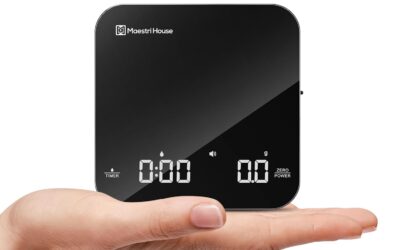
Use a running scale reading to avoid this mistake. After taring the brewing setup and adding the coffee, follow your recipe’s weighing sequence carefully. Many workflows tare again before adding water, so the display then shows cumulative water input. If you use a different sequence, write down what the display represents before pouring.
The Hario USA page presenting James Hoffmann’s V60 technique specifies 30 grams of coffee, 500 millilitres of water and a 60-gram bloom. It is a useful example of a complete recipe with staged pouring. Its details belong together; selecting only its bloom quantity while changing the dripper, dose and pour sequence creates a different recipe.
Choose a batch that fits the dripper
Check the manufacturer’s recommended batch size and compatible filter before scaling a recipe. Doubling the dose can make the coffee bed deeper, change flow and exceed the dripper’s useful capacity. Ratio arithmetic can be correct even when the resulting batch is unsuitable for the equipment.
Make sure the receiving cup or server can hold the finished drink with safe headroom. Set the equipment on a stable surface, and keep the scale and its charging port protected according to their instructions. A scale’s maximum load must accommodate the vessel, dripper, coffee and water, not merely the water quantity shown after taring.
Separate recipe strength from extraction problems
For a cup that tastes too concentrated, try adding a measured amount of water to a small serving. This is a serving adjustment, not the same process as brewing with a longer ratio. Water poured after brewing never travels through the coffee bed, so the two changes should not be described as interchangeable.
If the drink is weak and unpleasant, first check that you used the intended dose, counted all the water and weighed consistently. Then compare grind, filter fit and pouring with the recipe you followed. Do not assume that weakness proves you need a finer grind, or that bitterness proves you need a particular ratio.
A useful experiment keeps the coffee, dose, filter, grind and pouring method stable while changing only the planned water input within a suitable batch range. Record the result and repeat before deciding. If flow becomes erratic, return to the known recipe and investigate the workflow rather than changing several variables simultaneously.
Keep a short brew record
Record the coffee name, roast information when available, dry dose, total water, grinder and setting, dripper, filter, pouring sequence and approximate total brew time. Add a plain-language taste note after the coffee has cooled enough to drink. These details help explain why the same ratio can produce different cups.
Time is an observation, not a universal pass mark. Two drippers with different filters and batch sizes need not finish together. A sudden change compared with your own previous brews is more useful to investigate than a small difference from someone else’s internet recipe.
Common ratio questions
Does a 1:16 ratio guarantee the same caffeine?
No. The ratio states input quantities; it is not a caffeine measurement. Coffee composition, dose, brewing process and the amount actually served matter. Do not use this table to calculate caffeine intake or to make health claims.
Can I measure with tablespoons instead?
You can make coffee with household measures, but a tablespoon is a volume measure and does not hold a fixed mass of every coffee. For a repeatable mass-ratio recipe, weigh the grounds. If you choose a volume-based recipe, label it as such rather than presenting it as an exact gram calculation.
Related guides and source
See how to choose a pour-over scale for weighing limitations, and the pour-over knowledge hub for equipment and method connections. Compare workflows in French press versus pour over.
Primary recipe reference: Hario USA’s V60 technique page. Calculations and adjustment examples above are editorial explanations, not results of product testing. Reviewed October 12, 2026.