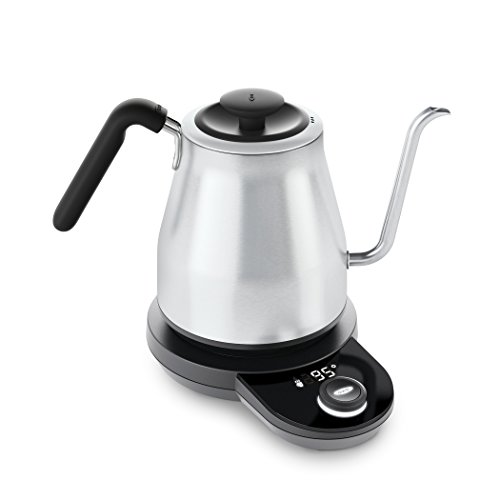
Gooseneck kettle flow rate explained means more than pouring slowly or quickly. It describes how much water leaves the spout over time, and how steadily you control that stream.
Pour rate changes coffee-bed agitation, saturation, drawdown, and brewing rhythm. You can use this guide to match kettle behavior with your recipe, technique, and tolerance for adjustment. For related kettle comparisons, see our coffee kettles category.
Buying and Brewing Guide: gooseneck kettle flow rate explained
Understand flow rate before choosing a kettle
Flow rate is the volume of water delivered during a period, commonly described informally as a slow, medium, or fast pour.
A slower stream gives you more time to target specific areas of the coffee bed. A faster stream covers ground quickly, but demands steadier wrist control to avoid uneven agitation.
Manufacturers do not always publish comparable flow-rate measurements. Spout design, kettle angle, water level, and pouring technique can change actual delivery, so treat labels as starting points.
Prioritize control over maximum speed
For pour-over coffee, controllable flow usually matters more than the fastest possible stream. Control helps you maintain a repeatable bloom and distribute later pours across the bed.
A kettle that responds gradually to small wrist movements can suit beginners. A highly responsive spout may offer finer adjustment, but it can punish abrupt movement during delicate pours.
Choose behavior that matches your recipe. If you use pulse pours, moderate control can simplify timing, while slow continuous pouring benefits from a stable, predictable stream.
Match flow to coffee-bed agitation
Agitation means movement of water and coffee grounds. Some agitation helps wet dry pockets and distribute dissolved coffee, while excessive movement can disturb the bed.
Pouring directly onto the coffee bed usually creates more agitation than pouring onto an already saturated surface. A narrow, controlled stream helps reduce accidental channeling from forceful impacts.
Channeling occurs when water finds easier paths through the grounds instead of extracting evenly. Flow control cannot fix every brewing problem, but it can reduce one source of inconsistency.
Consider spout geometry and kettle angle
Long, narrow gooseneck spouts generally support precise targeting, but geometry alone does not guarantee a gentle stream. Internal design and kettle balance also influence response.
A kettle that requires a steep angle may become harder to control as water leaves the vessel. Balance matters because wrist fatigue can change pouring speed during larger brews.
When specifications are limited, inspect product documentation for spout design, handle layout, temperature controls, and stated capacity. Avoid assuming similar silhouettes perform identically.
Match capacity to your normal batch
Capacity affects flow indirectly. A fuller kettle weighs more and may require greater effort to tilt, while a nearly empty kettle can feel overly reactive.
Choose enough capacity for your usual brew plus heating headroom, without making the vessel unnecessarily heavy. A single-cup brewer has different needs from a household making several servings.
Remember that stated capacity may exceed practical fill volume. Leave room for safe handling, especially when pouring hot water near a filter, dripper, or scale.
Evaluate temperature control separately
Temperature control and flow control solve different problems. Temperature influences extraction speed, while flow influences wetting, agitation, and delivery timing.
A kettle with precise temperature adjustment can support recipe changes, but it does not automatically produce balanced coffee. Grind size, dose, water chemistry, filter, and brew ratio still matter.
Temperature displays also require sensible interpretation. Displayed water temperature may differ from water reaching the coffee, particularly after lifting the kettle and pouring.
Account for speed, noise, cleaning, and ownership
Heating speed affects morning workflow, while pouring speed affects brew duration. A fast-heating kettle may still feel slow if its spout requires cautious, gradual pouring.
Noise can matter in shared homes, especially during early brewing. Controls should remain understandable, and the handle should support a secure grip without forcing awkward wrist positions.
Mineral buildup can affect heating performance and water contact surfaces. Follow manufacturer cleaning guidance, avoid abrasive materials, and confirm whether the kettle supports your preferred descaling routine.
For more context on ergonomics, compare the considerations in our guide to gooseneck kettles with comfortable handles.
How to adjust pour rate in practice
Start with a consistent recipe and change one variable at a time. Hold the kettle close enough for control, but avoid touching the brewer or disturbing its position.
Use a scale to monitor delivered water and timing. If the stream feels difficult to repeat, reduce wrist movement, stabilize your elbow, and pour in smaller controlled circles.
If coffee tastes harsh or finishes unusually slowly, excessive agitation may contribute, though grind size and filter behavior deserve attention too. If coffee tastes thin, faster pouring alone may not solve insufficient extraction.
| Brewing goal | Useful flow emphasis | Main caution |
|---|---|---|
| Gentle bloom | Slow, targeted stream | Do not leave dry pockets |
| Even saturation | Steady moderate stream | Avoid aggressive bed movement |
| Faster batch pouring | Stable higher flow | Watch timing and channeling |
Why You Should Trust Us
Our approach separates documented specifications from editorial interpretation. With no product data available for this guide, we do not assign product-specific winners, measurements, prices, or performance outcomes.
We assess kettle decisions through brewing mechanics, workflow, maintenance, ergonomics, and stated manufacturer information when available. That method keeps flow-rate advice useful without implying personal ownership or unsupported results.
Final Thoughts
No reviewed product list is available here, so a defensible best overall, best value, or best specific-use product cannot be named. Assigning those labels without product data would mislead shoppers.
For most pour-over users, prioritize predictable control, comfortable balance, suitable capacity, and easy cleaning. Buyers focused on recipe precision should add temperature adjustment, while simple brewers may prefer fewer controls and lower ownership complexity.
Use the flow principles above when comparing available models, then review our variable temperature kettle guide for a related decision framework.
FAQs
What does gooseneck kettle flow rate mean?
It describes how much water the kettle delivers over time and how easily you can control that delivery during brewing.
Why does pour rate matter for pour-over coffee?
Pour rate changes agitation, saturation, brew timing, and the chance of disturbing the coffee bed unevenly.
Is a slower flow always better?
No. Slower flow improves targeting, but suitable speed depends on recipe design, batch size, brewer shape, and your control.
Can flow rate fix bitter coffee?
Not by itself. Grind size, water temperature, brew ratio, water composition, and total contact time may also cause bitterness.
Does a gooseneck spout guarantee precise pouring?
No. Spout geometry helps targeting, but kettle balance, internal design, water level, and wrist control also shape the stream.
Should beginners choose variable temperature control?
Choose it if you expect to adjust recipes or brew different coffees. Simpler kettles may suit users prioritizing fewer controls and straightforward operation.
How can I make pouring more repeatable?
Use a scale, keep your recipe consistent, stabilize your elbow, and change only one brewing variable during adjustment.
What should gooseneck kettle flow rate explained help me choose in 2026?
It should help you prioritize controllable pouring, suitable capacity, comfortable handling, maintenance needs, and temperature features that match your routine. Our guide to gooseneck kettles without an app covers a simpler control preference.