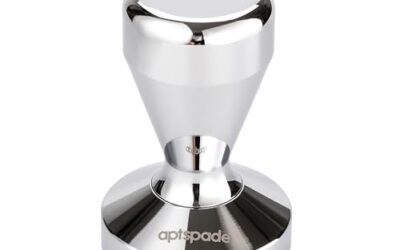

An espresso tamper needs to fit the basket inside your portafilter. The espresso tamper size chart below explains common size ranges, but measuring your basket is more reliable than choosing by machine brand.
This guide covers measurement, fit, base shape, and practical puck preparation. The product database currently lists 0 products, so the comparison block may not display product recommendations.
If you are also choosing accessories for a consistent workflow, our espresso dosing cup guide explains how dosing cups can help transfer ground coffee into a basket.
Basket dimensions vary, even among portafilters made for machines from the same brand. Treat chart ranges as a starting point, then verify the inside diameter of your specific basket.
Measure the basket, not the portafilter handle
Remove the basket from the portafilter if possible, empty it, and measure its inside diameter near the upper wall. A digital caliper gives a more useful reading than a ruler because small differences can affect tamper clearance.
Measure across the basket at more than one angle, keeping the caliper level. If readings differ, the basket may taper or your measurement may be tilted; use the narrowest working area to guide fit.
Use common size ranges as estimates
Espresso baskets commonly use nominal tamper sizes around 58 mm, 54 mm, and 51 mm, with other sizes also found. These figures describe broad categories, not a guarantee that every basket in that category has identical internal dimensions.
A chart can narrow your search, but do not order from the machine’s advertised portafilter size alone. Basket manufacturer, basket design, and the exact basket supplied can change the fit you need.
Choose a close fit without binding
The tamper base should enter the basket freely and leave little space around its edge. Too much clearance can leave a thin ring of grounds less compressed than the center, while an oversized base can catch or bind.
Do not force a tamper into the basket or assume a snug fit is correct if it scrapes the walls. Coffee grounds can collect in the gap, and a tight fit can make the tamper difficult to lift cleanly.
Consider base shape and basket profile
Flat bases are a straightforward choice for many standard baskets. Convex bases have a curved underside; whether that shape suits your setup depends on basket design and personal workflow, not size alone.
Some baskets have straight walls, while others taper or use ridges. Check the tamper’s usable base diameter against the area where the coffee bed sits, rather than judging fit only at the basket rim.
Separate diameter from leveling and pressure
A correctly sized tamper helps you compress the coffee bed across its surface, but size cannot compensate for uneven distribution. Break up clumps and distribute grounds evenly before tamping to reduce obvious gaps and sloped puck surfaces.
Press with a stable wrist and aim for a level bed. More force is not automatically better; consistent preparation and a level tamp matter more than chasing a particular pressure without a defined workflow.
Check handle comfort and daily upkeep
Handle shape and material affect grip, leverage, and storage, but they do not change the required base diameter. Choose a handle you can hold steadily and clean easily, especially if several people share the espresso setup.
Wipe coffee residue from the base after use and keep the tool dry between sessions. If you are assembling a broader puck-preparation setup, our coffee tamper guide covers tamper-related options, while our barista accessories category groups related equipment.
Why you should trust us
This guide uses general espresso basket and tamper principles to explain how fit affects puck preparation. The supplied product data contains no products or specifications, so we do not claim to have compared models, verified brand-specific dimensions, or tested equipment.
That limitation matters: a chart cannot confirm the dimensions of an unlisted basket. We recommend measuring your own basket and checking the tamper maker’s stated base diameter before buying.
Final thoughts
There is no defensible best-overall, best-value, or specialty-use product recommendation in this guide because no products were supplied. For most buyers, the practical choice is a tamper whose measured base fits the basket with minimal clearance and no binding.
If your basket dimensions are unclear, measure it first and contact the equipment or basket maker for confirmation. A nominal 58 mm, 54 mm, or 51 mm label can help shortlist options, but it should not replace checking the actual basket.
Keep the rest of your puck-preparation routine consistent before changing tools. A dosing cup can support cleaner transfers, and the espresso dosing cup guide offers related workflow context.
FAQs
How do I use an espresso tamper size chart?
Use the chart to identify likely size ranges, then measure your basket’s inside diameter. Confirm the tamper’s stated base diameter before buying, since nominal basket sizes do not guarantee exact compatibility.
How do I measure my espresso basket for a tamper?
Measure inside the basket near its upper wall with a caliper, keeping the tool level. Take readings across different angles and note any taper or variation.
Are 58 mm tampers interchangeable?
Not necessarily. The label may refer to a nominal size, while actual basket interiors and tamper bases can differ enough to affect clearance.
Should a tamper fit tightly in the basket?
It should fit closely but move freely. A base that binds can catch grounds or become difficult to lift; one with excessive clearance may leave coffee near the edge less compressed.
Does espresso machine brand determine tamper size?
Brand can help narrow the search, but it does not confirm a particular basket’s inner diameter. Measure the basket installed in your machine, especially if it has been replaced.
Does a larger tamper improve espresso extraction?
Not by itself. The relevant size is the one that fits your basket properly; even compression also depends on distribution and keeping the tamper level.
Is a flat or convex tamper base better?
Neither shape is universally better for every basket and workflow. Check basket compatibility, choose a base you can use consistently, and avoid treating shape as a substitute for even distribution.
What should I do if my tamper size is between chart entries?
Use a caliper to check the basket and compare the measurement with the tamper maker’s actual base diameter. Ask the maker or basket supplier to confirm fit when dimensions remain uncertain.
Can the espresso tamper size chart change in 2026?
Common nominal size categories remain useful, but new baskets and replacement parts may have different dimensions. For current equipment, verify the basket and tamper specifications rather than relying on a general chart alone.