Conical and flat burrs describe two grinding geometries, not two guaranteed flavour profiles. A conical set has a cone-shaped inner burr working against an outer ring; a flat set uses opposing disc-shaped burrs. To choose a grinder, compare its usable grind range, adjustment system, workflow and maintenance before treating burr shape as the deciding feature.
This is an editorial explanation of purchasing and recipe variables, not a laboratory comparison. We have not measured particle distributions, motor noise or retention for every grinder in either category. Claims that one geometry is always sweeter, quieter, cooler or more consistent are too broad to guide a reliable purchase.
What the geometry does and does not tell you
Burr geometry describes the arrangement of the grinding surfaces. It does not specify every detail of their cutting pattern, size, alignment, rotational speed or the path coffee takes through the grinder. Two machines described as conical can differ substantially, just as two flat-burr machines can.
The complete grinder matters. Its adjustment mechanism determines how you control the setting; its motor and control system affect operation; its chute and chamber affect the path from beans to collection. A useful comparison therefore identifies exact models rather than turning a broad component category into a prediction of the whole experience.
| Question | What to check | What burr shape alone cannot prove |
|---|---|---|
| Will it suit espresso? | Manufacturer’s intended use and fine adjustment | That every flat or conical grinder can dial in your machine |
| How much coffee remains inside? | Defined retention measurements for the model | A universal retention number |
| Will it fit my routine? | Hopper or single-dose workflow, controls and cleaning | That one geometry is always easier |
| How loud is it? | Comparable measurements and operating conditions | A fixed noise advantage for an entire category |
Start with your brew method and adjustment needs
List the methods you actually use: espresso, pour over, French press or a combination. Then check the manufacturer’s recommended applications for the exact grinder. The ability to produce visibly fine grounds is not sufficient evidence that a machine offers useful adjustment for a particular espresso setup.
For espresso, investigate the adjustment range and how changes are made. For a grinder shared between espresso and filter coffee, consider whether returning to previous settings is practical. For a filter-only routine, compare batch capacity, dose handling and ease of recording settings rather than paying for a feature you do not need.
Baratza’s espresso guidance discusses burr types in the context of its own machines and explicitly avoids declaring one type universally better. Manufacturer descriptions can explain intended use, but they are not an independent blind comparison of every competing grinder. Keep that distinction when interpreting a product page.
Do not turn particle distribution into a slogan
A grind sample contains a range of particle sizes. Describing all conical grinders as producing one distribution and all flat grinders as producing another skips the evidence needed to establish that claim. The burr design, condition, setting and measurement method would need to be specified in a meaningful comparison.
Similarly, a tasting observation from one coffee and recipe is not proof that the burr geometry caused it. Different water, dose, grind adjustment, filter and brewing technique can change a cup. When reading a review, look for the exact equipment and method, the variables held constant and whether the conclusion extends beyond the observations.
Words such as clarity, body and sweetness can describe a drinker’s experience, but they are not interchangeable with a measured particle distribution. A useful reviewer separates the measurement from the sensory description and states the limits of each. This guide does not invent either kind of result.
Distinguish retention from dose consistency
Retention concerns coffee remaining in the grinder, but comparisons must explain how it was measured. A simple input-versus-output weighing exercise can reveal a difference for that cycle; it does not necessarily tell you how much old coffee exchanged with new coffee inside the machine.
Dose consistency is a separate practical question. Record the beans weighed in and grounds collected across repeated, comparable cycles. Use the same scale and workflow, and note any purging recommended by the manufacturer. Do not present a single cycle as a universal retention specification, particularly when the grinder starts in an unknown state.
For a household switching between regular and decaf, exchange and cleaning requirements may matter more than a general burr label. Check whether the manufacturer explains a safe switching procedure. Do not assume that single dosing eliminates every trace of previous coffee or guarantees suitability for someone with a strict avoidance requirement.
Compare your own brews without changing everything
Use the same coffee, water, brewer and measured recipe when comparing setups. Record each grinder’s setting separately because their numbers are not equivalent. Adjust each machine appropriately for the recipe instead of choosing identical-looking numbers and calling the result a fair test.
Evaluate more than one brew after the workflow is stable. Record dose, total water, brew time where relevant and ordinary taste observations. If you alter the ratio while also changing grinders and filters, you cannot confidently attribute the difference to the burr geometry alone.
For pour over, the ratio calculation guide helps keep water input consistent. For immersion brewing, the first French press workflow provides a separate practical starting point. Neither method makes a grinder’s numbered settings transferable to another machine.
Check cleaning, service and long-term fit
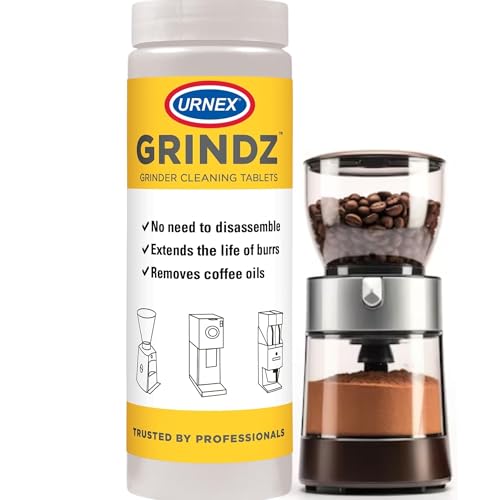
Read the model’s cleaning instructions before buying. Identify which parts the user may remove, whether tools are required and how the burr assembly is returned to its correct position. Disconnect power and follow the manufacturer’s safety procedure before user-serviceable cleaning; do not improvise an internal repair.
Confirm whether replacement burrs and other wear parts are available for the exact model and region. A visually similar burr is not proof of compatibility. Water, cleaning agents and abrasive materials can be unsuitable for grinding components, so do not assume a method approved for one grinder applies to another.
A practical buying decision
First eliminate models that do not support your brew method, counter space or batch needs. Next compare adjustment, dose workflow and cleaning. Finally consider well-documented model-specific performance evidence and price. Burr geometry can remain part of that comparison, but it should not replace the other checks.
If two suitable models remain, choose the one whose daily workflow you understand and can maintain. A more expensive geometry does not automatically repair an inconsistent recipe, and a simpler grinder is not automatically unsuitable merely because of its burr category.
Source and related knowledge
Primary reference: Baratza’s guide to dialing in espresso. Its model-specific discussion informs the distinction above; we do not treat its product descriptions as universal measured results. Reviewed October 12, 2026.
The coffee grinder knowledge hub connects equipment selection, adjustment and brewing workflow without requiring a product purchase to understand the concepts.