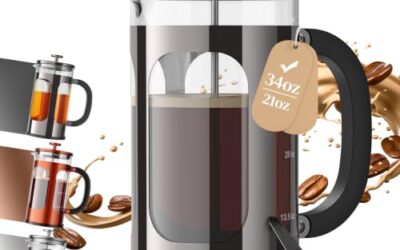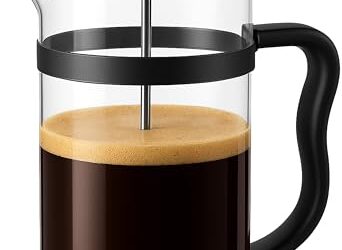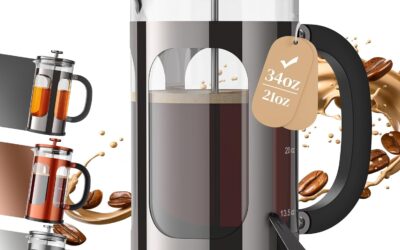

To use a French press for the first time, measure coffee and water, steep according to your brewer’s instructions, lower the plunger gently, and pour the coffee into cups. The plunger separates most grounds from the drink; it is not an espresso-style pressure system. Never force a plunger that resists movement.
This guide separates a practical measuring example from manufacturer instructions. It is an editorial explanation, not a report of hands-on testing. Different presses have different capacities, materials and care requirements, so the manual supplied with your model takes priority.
Check the press before adding hot water
Set the press on a level, stable surface away from a counter edge. Check that the vessel has no cracks or chips, the handle is secure, and the filter assembly is fitted as shown in the manual. A damaged glass vessel should not be used for brewing. Keep children clear of the work area and handle a filled press as a container of hot liquid.
You need ground coffee, suitable water, a timer and a spoon permitted by the manufacturer. A scale makes the recipe easier to repeat, but you do not need to buy a new press or accessories to understand the method. Avoid metal utensils against glass when the manual specifies otherwise. Check the maximum fill level before deciding your batch size.
Measure a batch that fits your actual cups
French press cup counts can be misleading. Bodum’s capacity guidance uses small four-ounce cups, not the size of every household mug. Compare the stated millilitre or ounce capacity with your serving plan, then leave the headspace required by the manufacturer. Do not assume that a press labelled for eight cups will fill eight large mugs.
As a measuring example, 20 grams of coffee and 320 grams of water gives a coffee-to-water ratio of 1:16. This is an adjustable starting example, not a universal manufacturer recipe or a promise of a particular taste. A larger batch using the same ratio would use 30 grams of coffee and 480 grams of water, provided the vessel can safely accommodate it.
| Coffee | Water added | Calculation |
|---|---|---|
| 15 g | 240 g | 15 × 16 |
| 20 g | 320 g | 20 × 16 |
| 30 g | 480 g | 30 × 16 |
The finished drink will be less than the water input because liquid remains with the grounds and some can remain in the vessel. Measure your poured serving if you need to plan portions precisely. Do not add more water beyond the safe fill line just to recover the difference.
Use a grind intended for a French press
Bodum’s French press instructions call for coarse ground coffee. Follow your own brewer’s guidance rather than copying a numbered grinder setting from another model. Grinder numbers are not a shared measurement system: setting 20 on one machine need not resemble setting 20 on another.
For a first attempt, ask a roaster for coffee ground for your press if you do not own a suitable grinder. Keep a note of the coffee and grind you used. A change of coffee, grinder or filter can change the result, so a successful recipe is more useful when its ingredients and process are recorded.
Add water, steep and plunge carefully
- Measure the coffee into the clean vessel. Prepare the chosen water quantity separately, checking the brewer’s temperature guidance.
- Add water using the method in the manual. Wet the grounds as directed, without filling above the permitted level. If the instructions call for stirring, use an appropriate utensil gently.
- Position the lid as instructed and start a timer. Bodum’s Chambord instructions use a four-minute steep; that is a manufacturer example, not a rule for every press or recipe.
- Hold the press securely in the manner shown by the manufacturer and lower the plunger slowly. Keep your face and hands away from a possible hot-liquid splash.
- Pour into cups once the coffee is ready. If you are serving later, use a separate suitable container rather than treating the press as indefinite hot storage.
If the plunger is difficult to lower, stop applying pressure. Check the manual’s advice after making the situation safe; do not force the handle, lean your body weight onto it or attempt to dismantle a hot, full press. A poorly assembled filter, an unsuitable grind or excess grounds may need attention before the next brew.
Taste the result before changing the recipe
Let the drink cool enough to taste safely. Describe what you notice in ordinary terms: too strong, too weak, gritty, unpleasantly sharp or drying. Those observations are more actionable than simply recording that the coffee was bad. Strength and flavour balance are related, but they are not the same thing.
If a cup is stronger than you prefer, compare a small portion with a measured amount of added water. If dilution improves it, adjust the next batch’s ratio while keeping the other steps stable. If the flavour remains unpleasant after dilution, check the coffee, grind, water and process rather than assuming that more water fixes every problem.
Change one variable at a time and record the result. Do not treat sourness as proof of one particular fault, or bitterness as an automatic instruction to shorten every brew. Coffee choice and personal preference matter, and a single taste description is not a complete diagnosis.
Clean up without damaging the filter
Allow the equipment to cool, discard the grounds appropriately, and clean the parts according to the manual. Do not wash a mass of grounds down the drain. Disassemble the filter only as instructed, keeping track of the order of its components. Rinse away trapped particles and dry the parts before storage.
Check whether each component is dishwasher-safe instead of assuming the entire press is. Replace damaged mesh or seals with compatible parts. Persistent residue deserves careful cleaning, not stronger plunging force. Safe assembly and routine care are part of making the next brew repeatable.
What to read next
For the difference between steeping coffee and pouring through a filter, read French press versus pour over. To compare measured recipes in another method, see our pour-over ratio guide. The French press knowledge hub connects the method, serving size and buying decisions.
Sources and editorial scope
Manufacturer references: Bodum Chambord instructions and Bodum capacity FAQ. The ratio table is our arithmetic example, not a measured performance result. Reviewed October 12, 2026; this guide does not claim that a particular press has been tested by our editors.