
Watching an espresso shot gush into the cup in ten seconds is one of the most frustrating moments in home brewing. Fast extraction produces a pale, sour beverage with thin body and virtually no crema. Getting consistent results starts with understanding how water meets coffee puck resistance on your counter setup.
Whether you pull shots on compact beginner gear or commercial-style boilers, flow rate directly dictates taste. Exploring our guides to the espresso machines category helps reveal how mechanical design and barista technique combine for cleaner, sweeter shots.
Grind Size Calibration and Particle Distribution
Grind size is the single most common variable causing rapid flow during extraction. When grounds are too coarse, generous space between particles allows pressurized water to flow through the coffee bed with minimal resistance.
Moving your grinder to a finer setting packs those particles closer together. This restricts water passage and forces the pump to build true brew pressure. Fine adjustments change extraction time by several seconds per notch, so make small step changes while keeping other variables identical.
High precision manual or electric grinders deliver uniform particle size that prevents micro-channels. Investing in quality gear, such as examining our Comandante C40 review, illustrates how consistent particle distribution stabilizes shot duration.
Coffee Dose and Basket Headspace
Dose weight determines puck volume and its relationship to the shower screen. An underfilled portafilter basket leaves excessive headroom, allowing incoming water to disrupt the surface of the coffee cake before pressure stabilizes.
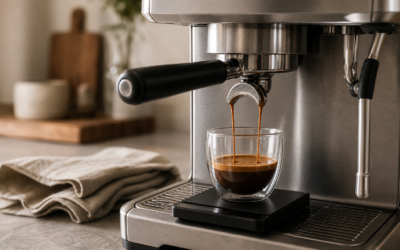
Using a precision scale to measure input within a tenth of a gram eliminates guesswork. Our breakdown of the best digital coffee scales for espresso brewing explains why consistent dosing forms the foundation of shot repeatability.
Verify that your dose matches the basket specification, such as eighteen grams for a standard double basket. Increasing your dose slightly increases resistance and slows down shot delivery when grinder adjustments are too wide.
Tamping Technique and Puck Leveling
Uneven tamping creates density variations inside the portafilter basket. Water naturally seeks paths of least resistance, rushing through loosely packed zones while leaving denser sections dry.
Leveling tools and needle distribution devices break up clumps before you compress the coffee. Once the bed is flat, apply firm, level downward pressure until the coffee bed resists further movement.
Tamping hard will not fix a grind that is far too coarse. Consistent depth and a completely flat horizon matter far more than extreme muscle force when aiming for a steady thirty-second extraction.
Coffee Bean Freshness and Degassing
Stale coffee beans lack the carbon dioxide necessary to create backpressure during brewing. As roasted beans age past several weeks, cellular structure degrades and allows water to saturate and pass through much too quickly.
Fresh beans roasted within two to four weeks release natural gases that emulsify into dense crema. That carbon dioxide release actively resists water flow and helps regulate standard extraction timing.
Store whole beans in sealed, opaque containers away from heat sources. Grinding immediately before extraction preserves bean moisture and aromatic oils, preventing sudden increases in flow speed across daily sessions.
Basket Type and Portafilter Selection
Many entry-level home machines ship with pressurized, dual-wall filter baskets designed for pre-ground grocery coffee. Switching to a commercial unpressurized single-wall basket immediately exposes grind flaws and alters flow speed dramatically.
Unpressurized baskets rely entirely on the coffee bed to produce brew pressure. If your grind is not fine enough, water escapes quickly through hundreds of precision-machined holes across the bottom surface.
Check whether your machine uses a standard fifty-eight millimeter portafilter or smaller consumer sizes. For machines like the DeLonghi dedica vs breville bambino, basket diameter directly influences puck depth and flow dynamics.
Water Pressure and Machine Warmup
Cold groupheads and fluctuating boiler temperatures disrupt how coffee compounds dissolve. When metal components are lukewarm, initial extraction suffers and water flow can behave erratically.
Allow your espresso machine at least fifteen to twenty minutes to reach thermal equilibrium before pulling shots. Running a blank water flush warms the portafilter metal, shower screen, and internal valves thoroughly.
Reviewing comparisons like the Breville Bambino vs Bambino Plus shows how instant thermo-jets manage heating compared to traditional boiler architectures, influencing early shot resistance.
Why You Should Trust Us
Our editorial guidance relies on proven extraction physics, fluid dynamics, and industry-standard barista methodology. We analyze specifications, component design, and extraction variables using documented manufacturing tolerances and professional brewing science.
We focus on actionable diagnosis rather than promoting unnecessary equipment purchases. By isolating one variable at a time, our recommendations help home brewers resolve workflow bottlenecks with clarity and transparency.
Final Thoughts
Solving rapid espresso flow requires a calm, systematic diagnostic process. Instead of changing multiple settings simultaneously, adjust only your grind size finer first while holding dose weight and tamp pressure strictly constant.
Keep a detailed notebook next to your machine to record input grams, output yield, and extraction seconds. Small daily observations quickly reveal how roast age, room humidity, and basket mechanics interact on your countertop.
With patient calibration, your espresso shots will hit the target twenty-five to thirty-second window. Proper flow rate unlocks full sweetness, viscous crema, and balanced acidity in every cup you brew.
FAQs
What is the ideal extraction time for an espresso shot in 2026?
A standard double espresso typically targets an extraction duration of twenty-five to thirty seconds from pump activation. This window yields roughly double the dry coffee weight in liquid espresso with optimal sweetness and balanced acidity.
Why does my espresso shot run too fast even on the finest grinder setting?
If your grinder cannot slow down the flow at its finest notch, the burrs may lack proper calibration or the beans could be stale. Older beans lose moisture and resistance, while some multi-purpose grinders simply lack the fine micro-adjustments needed for unpressurized espresso baskets.
Does tamping harder stop an espresso shot from running too fast?
No, tamping with excessive force will not compensate for a grind that is too coarse. Once the coffee bed is fully compressed, additional pressure cannot squeeze the particles closer together, so adjust your grind finer instead.
How does coffee bean roast date influence extraction speed?
Beans roasted months ago have lost internal carbon dioxide and essential aromatic oils. Without natural gas expansion to create resistance against incoming water, stale coffee allows fast, watery shots with thin crema.
What does channeling mean in fast espresso brewing?
Channeling occurs when pressurized water carves narrow tunnels through cracked or unevenly distributed grounds. Water rushes through these cracks rather than saturating the puck evenly, creating high flow rates, bitter streaks, and weak extraction.
How does basket size impact shot flow rate?
Basket size dictates the physical depth of the coffee puck. Underfilling an eighteen-gram basket with only fourteen grams reduces the puck thickness, allowing water to pass through much faster unless the grind is substantially finer.
Can using a pressurized basket help if my espresso shot runs too fast?
Pressurized baskets force coffee through a single pinhole to artificially generate resistance and crema. This works well for pre-ground coffee, though choosing a machine from the best compact espresso machine lineup offers true unpressurized control for superior flavor clarity.
Should I adjust my water temperature if shots are flowing too fast?
Water temperature mainly influences solubility, flavor balance, and acidity rather than mechanical flow resistance. Address grind size, distribution, and dose weight first before altering boiler temperature settings on your machine.