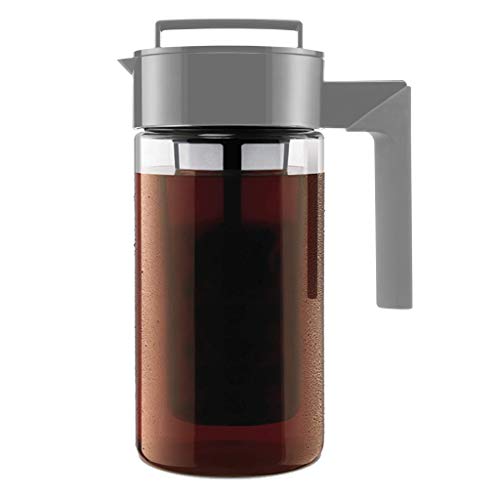
A cold brew coffee ratio needs two labels: the coffee-to-water ratio used for brewing and the concentrate-to-water ratio used for serving. They answer different questions. A 1:5 brewing ratio by mass means 100 grams of dry coffee with 500 grams of water. A 1:2 serving dilution means one part finished concentrate plus two parts water or milk.
Neither number alone identifies a complete cold brew recipe. The brewer, filtration, grind, steeping conditions and intended serving strength also matter. This guide explains the arithmetic and how to read a recipe without mixing up its units. It does not establish a universal ideal ratio or report a hands-on brewer test.
Brewing ratio and serving dilution are separate
Brewing starts with dry grounds and water. Serving starts with the liquid you collected after filtration. Grounds retain liquid, so the concentrate yield is not equal to the water you poured into the brewer. Do not divide coffee weight by the collected concentrate and call that the original brewing ratio.
For clarity, label a recipe as coffee:water and state the units. For the serving stage, label it concentrate:added liquid. A bare instruction such as use 1:2 is ambiguous because it could refer to different ingredients and steps. Writing out the quantities avoids a surprisingly common kitchen mistake.
Calculate the brewing inputs
When both ingredients are measured by mass, water equals the dry coffee dose multiplied by the ratio number. The table shows the mathematics for three example inputs. It is not a recommendation that every cold brew device can use all three, and it does not rank their taste or caffeine content.
| Dry coffee | Water at 1:5 | Water at 1:8 | Water at 1:12 |
|---|---|---|---|
| 50 g | 250 g | 400 g | 600 g |
| 100 g | 500 g | 800 g | 1,200 g |
| 150 g | 750 g | 1,200 g | 1,800 g |
The required vessel space includes the grounds and appropriate headroom, not just the water. Check the manufacturer’s usable capacity before scaling. A filter basket can have a separate coffee capacity limit even when the surrounding pitcher appears large enough. Do not pack extra grounds into a basket simply to fit a calculated dose.
Read manufacturer quantities without changing their meaning
The Toddy home-system instructions specify 340 grams of coffee and 1.9 litres of water for their standard batch. These are a coffee mass and a water volume, so quoting them as an exact mass ratio would be misleading. The manual also distinguishes its filter-bag method from its felt-filter-only method.
That distinction matters because instructions about wetting and stirring depend on the filter setup. Follow one complete method for the equipment you own instead of combining quantities from one recipe with handling instructions from another. A recipe that works in a large open brewing container is not automatically appropriate for a compact pitcher with a narrow mesh insert.
Record the exact units in your notes. If you weigh water for convenience while following a volume-based manual, acknowledge that you have adapted the measuring method. Do not silently convert rounded manufacturer quantities into an apparently precise new specification.
Calculate dilution using the finished concentrate
For a concentrate:water dilution of 1:2, add two equal parts of water to one part concentrate. Using volume for this serving example, 100 millilitres of concentrate plus 200 millilitres of water gives approximately 300 millilitres before ice. It does not mean adding water until the total reaches 200 millilitres.
| Concentrate | Added water | Combined liquid before ice |
|---|---|---|
| 50 mL | 100 mL | About 150 mL |
| 100 mL | 200 mL | About 300 mL |
| 150 mL | 300 mL | About 450 mL |
Toddy gives a one-part-concentrate, two-parts-water-or-milk serving example for its system. Treat that as a starting instruction for that concentrate, not a universal rule for all cold brew. A batch intended to be ready to drink may need no dilution. Taste a small, measured serving first and keep notes on your preferred mixture.
Include milk and melting ice in the serving plan
If you replace added water with milk, write down that substitution. The serving volume may look similar, but milk changes the drink’s flavour and composition. If you add syrup, record its amount separately rather than pretending it is part of the original brewing ratio.
Ice adds water as it melts. Compare recipes using a consistent ice amount and drinking time if you want useful observations. A drink that seems balanced immediately after mixing can become more diluted later. You can adjust the serving mixture without remaking the entire brewing recipe each time.
Use a measured troubleshooting sequence
If the drink is too strong, dilute a small sample and evaluate it before changing the next batch. If dilution improves strength but not an unpleasant flavour, inspect the coffee, filtration and brewing method. More serving water cannot reverse every extraction or handling problem.
If the drink seems weak, check whether you accidentally diluted ready-to-drink coffee, used the wrong ratio convention or measured grounds by an inconsistent scoop. Verify the recipe quantities before increasing the coffee dose. Change only one controllable variable for the next batch, then compare at the same serving dilution.
Cold brew is not automatically low in caffeine, and a darker-looking concentrate is not a caffeine measurement. This article’s ratios cannot support health or caffeine-dose conclusions. They describe kitchen inputs and serving arithmetic, not laboratory analysis.
Plan handling, storage and batch size
Use clean, food-suitable equipment and follow the brewer’s instructions for steeping conditions, filtering and storage. Different systems specify different procedures; this guide does not replace them with a universal room-temperature schedule. Label the batch with its preparation date and ingredients so household members know what it contains.
Refrigerate the finished coffee as directed and consult appropriate food-safety guidance for your circumstances. Do not infer that a manufacturer storage suggestion makes every homemade batch safe for the same period. Milk-added drinks require their own handling considerations. Make a batch you can manage rather than increasing volume simply because the ratio scales mathematically.
Source and next step
Primary reference: Toddy home-system instruction manual. Its quantities and serving example are identified above; the tables are our arithmetic examples. Reviewed October 12, 2026, without a claim of independent product testing.
Continue with the cold brew knowledge hub to connect recipe planning with filtration and equipment. For a hot-brewing comparison, see how pour-over ratios count water.